
Grounding Is Not Proof: 100% Code, 0% Plan Quality
Why a 100% task completion rate does not guarantee plan quality, and how pre-finalization checks prevent hallucinated path claims.
It’s easy to assume that if an AI finishes a task without crashing, it did a good job. But what if it confidently hands you a finished blueprint that cites nonexistent materials? In the world of AI agents, evaluating systems purely by whether they finish a task creates dangerous illusions of competence. An AI can execute perfectly, hit no errors, and yet submit a plan full of fabricated file paths and unverified claims.
In this study, we tested several top-tier AI models—including Gemini 3.6 and DeepSeek v4—and discovered why a 100% completion rate means nothing if the AI’s work isn’t strictly “grounded” in reality. More importantly, we show how to build safeguards that force the AI to double-check its facts before submitting its final answer.
1. The Execution vs. Quality Paradox#
During matrix benchmarks, Gemini 3.6 model tiers consistently achieved 100% execution completion (0 runtime crashes, 0 budget pauses). However, when evaluated against strict quality gates checking whether cited file paths were actually read via view_file() or grep_search(), all provider groups failed the quality gate (BLOCKED (0%)).
Benchmark Study Matrix#
| Provider Group | Completion Rate | Mean Score | Grounding Ratio | Quality Gate Status | Mean Tokens | Mean Elapsed (s) |
|---|---|---|---|---|---|---|
cliproxyapi-gemini-3.6-flash-high | 100% | 1.00 | 75% | BLOCKED (0%) | 44,080 | 222.8s |
cliproxyapi-gemini-3.6-flash-medium | 100% | 1.00 | 0% | BLOCKED (0%) | 17,642 | 38.0s |
cliproxyapi-gemini-3.6-flash-low | 100% | 1.00 | N/A | BLOCKED (0%) | 18,354 | 64.7s |
deepseek-v4-flash | 33% | 0.33 | 100% | BLOCKED (0%) | 84,847 | 316.3s |
Key Takeaway: Gemini models ran fast and completed 100% of tasks, but cited file paths they had never inspected. DeepSeek achieved 100% path verification on the 33% of runs that completed, but consumed 4.8x more tokens and hit step ceilings.
2. Pre-Finalization Intercept & Self-Correction#
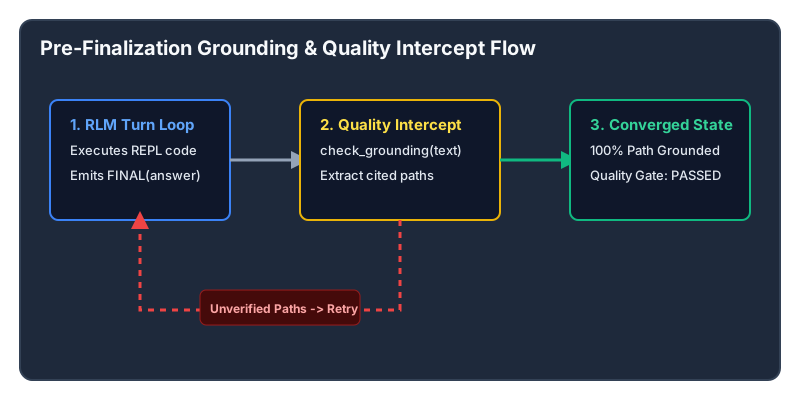
To eliminate ungrounded answers without forcing full trajectory reruns, we implemented a Pre-Finalization Quality Intercept in our orchestration framework.
Intercept Implementation#
When a model attempts to emit FINAL(answer), our orchestration framework extracts path claims and checks them against check_grounding(). If unverified paths are found:
# orbit_harness/rlm/general/rlm.py
if grounding.unverified and grounding.claimed:
    self._self_correction_attempts += 1
    unverified_str = ", ".join(grounding.unverified[:5])
    message_history.append(
        Message(
            role="user",
            content=(
                f"[Quality Check Alert]: The plan answer contains {len(grounding.unverified)} "
                f"unverified file path(s): {unverified_str}. Execute view_file() or grep_search() "
                "to inspect and confirm these files exist before calling FINAL()."
            )
        )
    )
    final_result = None
continue # Allow agent to inspect missing paths3. Counterfactuals & Falsification#
Counterfactual: LLM-as-a-Judge Evaluation#
- Why Rejected: Prompting a secondary LLM to judge plan quality frequently scores plausible-sounding, well-formatted markdown plans as 10/10, even when the cited file paths do not exist. Deterministic path resolution against the real host filesystem is non-gameable.
4. Key Takeaways#
- Completion Rate Quality: Never rely on binary task completion as proof of model capability.
- Pre-Finalization Intercepts Work: Pausing finalization to report ungrounded paths forces self-correction without wasting prior trajectory steps.
- Deterministic Evaluation: Grounding ratio and required-finding checks provide unambiguous quality signals for agent benchmarks.