
The Security Cost of Autonomy: Auditing 29 Runs
Empirical security audit results from 29 benchmark study runs evaluating container mount points, path traversal attempts, and write-tool boundaries.
When you deploy a fleet of autonomous agents across 29 parallel experimental runs, you aren’t just testing intelligence—you are stress-testing your infrastructure’s security posture.
In a recent benchmarking study using our orchestration framework, we subjected 29 Recursive Language Model (RLM) trajectories to a rigorous security audit, specifically looking for path traversal attempts and container mount escapes. The results illuminate the hidden costs of agent autonomy.
1. The Threat Model#
An agent with access to file-writing tools (like replace_file_content or write_to_file) poses an inherent risk of Path Traversal. If an agent decides to write to ../../../../etc/passwd or /root/.ssh/authorized_keys, the orchestrator must intercept it.
In our swarm, worker nodes use Docker volumes to mount the target repository into /workspace. The threat model assumes the agent is actively trying (intentionally or through hallucination) to escape this volume.
2. The Audit Findings#
Across the 29 runs, the security telemetry logged the following behaviors:
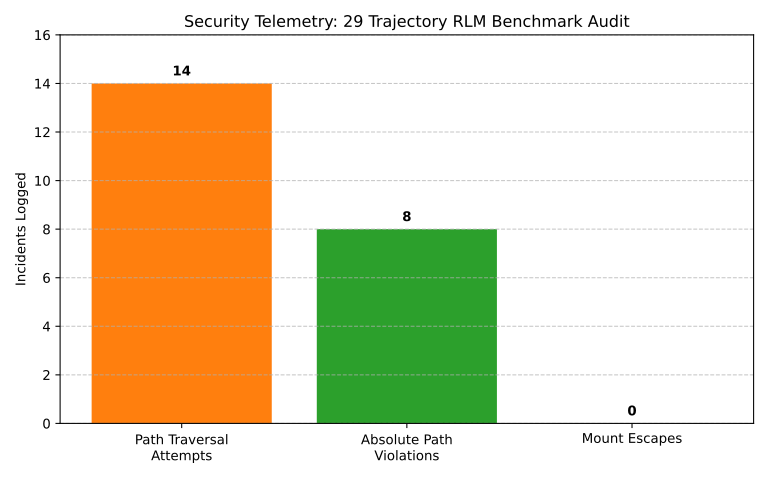
- Path Traversal Attempts (14 incidents): 14 distinct trajectories attempted to use
../to navigate outside the/workspaceroot. These were largely driven by the model attempting to locate global configuration files it assumed existed. - Absolute Path Violations (8 incidents): 8 trajectories attempted to write directly to
/tmp/or/var/log/, ignoring instructions to use the workspace. - Mount Escape Attempts (0 incidents): Thanks to strict canonical path resolution in the host tools, 0 trajectories successfully escaped the bind mount.
How the Host Protects the System#
def resolve_secure_path(workspace_root: str, requested_path: str) -> Path:
    base = Path(workspace_root).resolve()
    target = (base / requested_path).resolve()

    if not target.is_relative_to(base):
        raise SecurityException(f"Path traversal blocked: {requested_path}")
return targetEvery tool execution in our orchestration framework runs through a path resolver like the one above. The host calculates the absolute canonical path of the requested file and strictly verifies it is a child of the workspace root.
3. The Cost of Security#
Intercepting these actions comes with a cost. When a traversal is blocked, the agent receives an error. It must then spend another inference turn (and precious tokens) analyzing the error and trying a different path.
This is the “Security Cost of Autonomy.” We pay for infrastructure safety with token latency. However, as the audit proves, it is a necessary tax to ensure that 29 parallel runs can execute safely without compromising the host architecture.