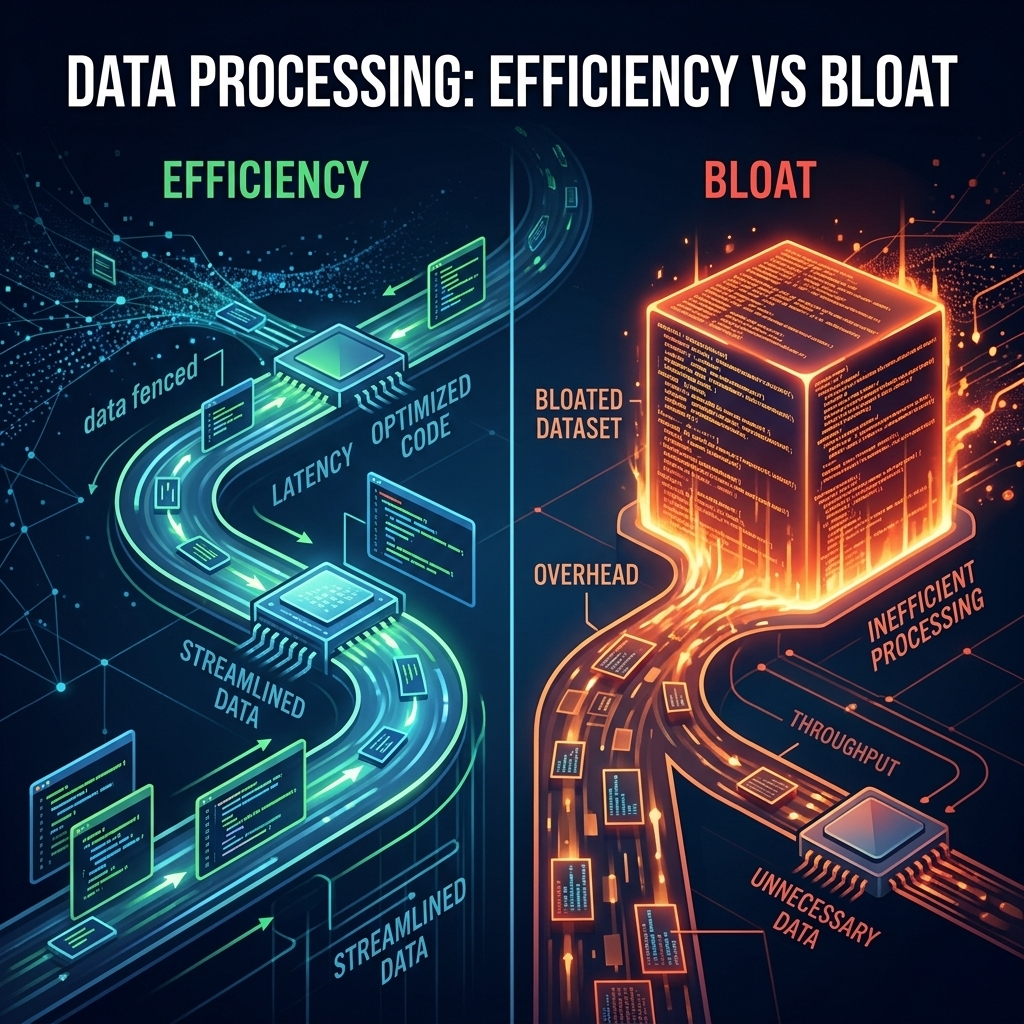
The Token Efficiency Curve: Fences vs. Context Dumps
Analyzing how single-cell turn discipline impacts context growth and token costs.
As context windows for Large Language Models expand into the millions of tokens, a dangerous anti-pattern has emerged in agent engineering: the “Context Window Dump.”
Instead of teaching agents to precisely navigate a repository, developers simply dump the entire codebase into the prompt. While this might yield quick results for trivial scripts, it destroys token efficiency and creates massive latency bottlenecks in recursive, multi-turn trajectories.
1. The Cost of the Dump#
In a Recursive Language Model (RLM) loop, the context window grows with every turn. The agent sees the initial prompt, its own tool calls, and the tool responses.
If you dump a 100,000-token codebase into the initial prompt, and the agent takes 15 turns to solve a problem, you are paying to process those 100,000 tokens 15 times.
This isn’t just expensive financially; it incurs massive Time-to-First-Token (TTFT) latency, slowing down the entire swarm.
2. Single-Cell Turn Discipline#
In our orchestration framework, we advocate for Small Code Fences and Single-Cell Turn Discipline.
Instead of dumping the codebase, the agent is given a strict set of precise tools (grep_search, view_file with line number constraints). The agent must actively explore the codebase, pulling only the snippets it needs.
The Efficiency Curve#
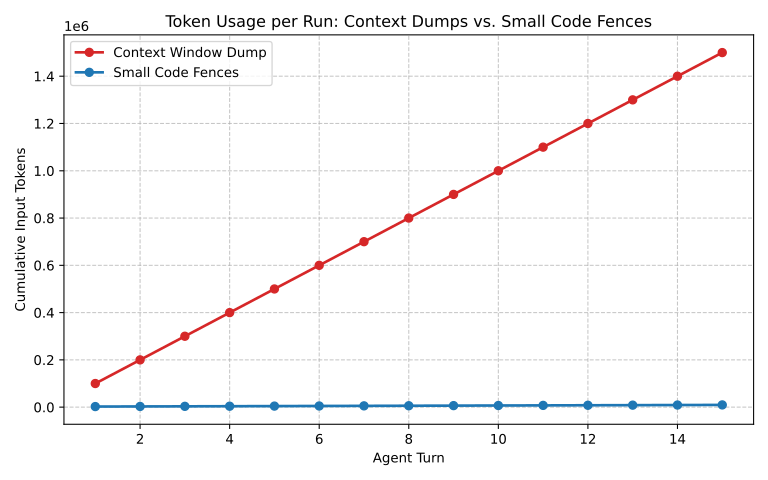
When an agent uses targeted tools, its context window starts small and grows linearly only with the specific information relevant to the task.
- Turn 1:
grep_search("AuthModule")(Returns 500 tokens of results). Total Context: 2,500 tokens. - Turn 2:
view_file("auth.py", start=10, end=50)(Returns 300 tokens of code). Total Context: 3,000 tokens. - Turn 15: Total Context: 15,000 tokens.
By enforcing discipline, we achieve a >90% reduction in token usage compared to the dump method, while drastically improving execution speed.
3. Engineering for Precision#
LLMs are capable of processing millions of tokens, but that doesn’t mean they should. Massive context windows should be reserved for problems that inherently require massive context (like reading a 500-page PDF), not as a crutch to avoid building proper search and navigation tools for your agents.
To build production-grade agent swarms, optimize for precision. Small fences build efficient agents.