
Grounding Is Necessary, Not Sufficient
File-path grounding blocks a class of fabricated plans, but it cannot establish that a cited file supports the claim being made.
Grounding is often described as the cure for hallucinated agent plans: require the planner to cite real repository files and reject the plan when it cannot. That is necessary. It is not enough.
The key distinction is between reference validity and claim validity. A file can exist while being the wrong test, a neighbouring implementation, or documentation that describes a different execution surface. A planner that cites it has grounded a string, not necessarily an assertion.
What strict grounding changed#
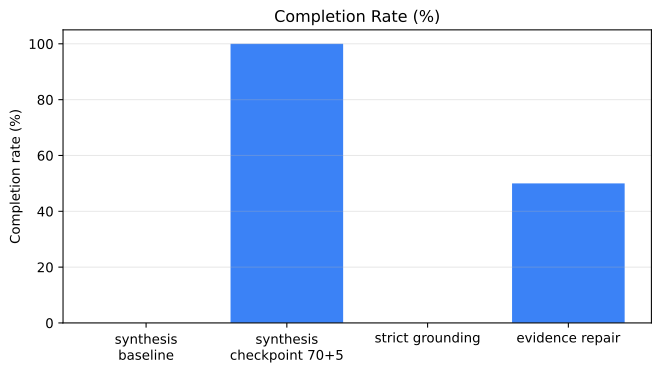
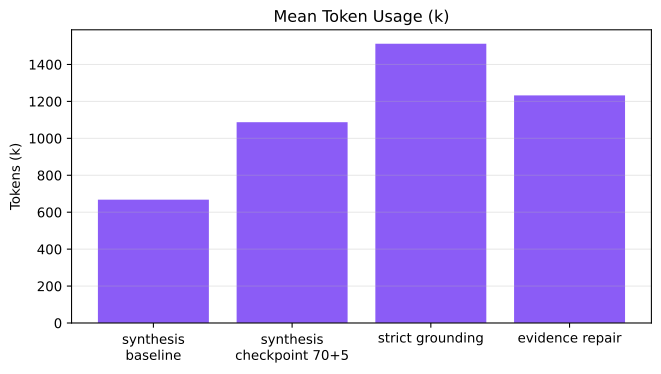
The strict plan-reference cohort used the same indexed planner and a checkpoint-70-plus-five budget policy, but required each task to provide scope, evidence, and tests. It terminated at 0% completion after 77 mean iterations, approximately 1.51 million mean tokens, and 15 plan-validation failures. The error mix was evenly split across missing evidence, scope, and tests.
That is not a failure of the principle. It shows the validator was able to prevent under-specified plans from being accepted. An earlier evidence-reference repair cohort reached 50% completion, 50% verification, and 11 verified references out of 12 claimed. It demonstrates that the planner can sometimes use repair feedback to obtain real evidence.
| Cohort | Repeats | Completion | Grounding | Mean tokens | Validation failures |
|---|---|---|---|---|---|
| Strict reference grounding | 1 | 0% | n/a | 1.51m | 15 |
| Evidence-reference repair | 2 | 50% | 91.7% | 1.23m | 3 |
| Checkpoint candidate | 2 | 100% | 100% | 1.09m | n/a |
The table comes from data/study-metrics.csv. The study manifests, scoreboards, reports, and hashes are recorded in data/evidence-manifest.yaml.
The worked failure: valid files, invalid plan#
Manual review of accepted checkpoint plans exposed why existence checks are only the first layer.
- The plans cited test paths under the wrong package root; the relevant tests were under
tests/unit/.... - They attributed network isolation and environment-key scrubbing to one Docker backend when the evidence belonged to different repository surfaces.
- They presented intentional paused-state behaviour and normal success routing as failure modes.
Every example sounds plausible in a natural-language summary. None is safe to implement from. The important failure is not “the agent made up a filename.” It is “the agent assembled a claim from nearby facts without establishing the component-level relationship.”
A hierarchy of evidence checks#
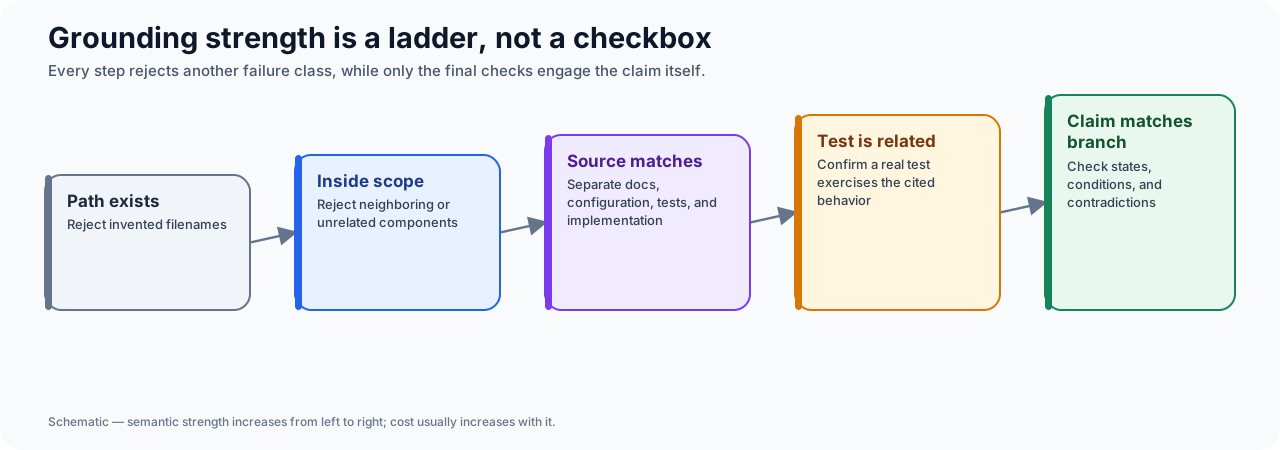
| Check | Rejects | Still permits |
|---|---|---|
| Path existence | Invented filenames | Wrong existing file |
| Scope membership | Files outside the task | A too-broad but in-scope citation |
| Source-type match | Documentation used as implementation evidence | Misread implementation branch |
| Related-test validation | Unrelated or nonexistent tests | A real test that does not exercise the claim |
| Claim-to-branch review | Contradictions with inspected code | Future behaviour changes |
This hierarchy suggests an implementation order: add cheap, deterministic checks early, then reserve semantic review for claims with high downstream cost. Do not attempt to solve semantic correctness by making the schema increasingly elaborate.
Counterfactual: when path grounding is enough#
Path grounding is sufficient for some narrow tasks. If a plan’s only duty is to name existing files for a static inventory or migration checklist, source type and branch semantics may not matter. The moment a plan proposes a behavioural change, explains a failure mode, or chooses a test, existence becomes a weak proxy.
The falsifier for this article’s claim is straightforward: show that adding existence checks alone reliably rejects the wrong-test and wrong-component examples in a held-out cohort. The current evidence does not show that; the manual review shows the opposite.
What to add next#
Three gates are high-value:
- Compare each cited test path with the repository’s actual test roots and the task’s declared component.
- Require implementation claims to cite implementation branches, not only security documentation or manifests.
- Add a contradiction-oriented review prompt: name the claimed wrong-state branch and the claimed recovery branch, then verify both against code.
These should complement, not replace, strict path checks. Grounding prevents a plan from floating free of the repository. Semantic review prevents it from becoming confidently wrong inside the repository.
Cohort results at a glance#
Takeaways#
- A real path is evidence of a file, not evidence of a claim.
- Grounding metrics must state their level: existence, scope, source type, or semantic support.
- Manual semantic review is expensive; use it where a plan becomes an execution contract.
Read A Plan Can Validate and Still Be Unsafe to Implement for the broader readiness model.