
RLM Is Not Automatically Token-Efficient
Recursive loops are not token-efficient by default. Compaction plateaued input near 14-16k per call and cut a 25-step run from ~1.04M to ~367k tokens.
Thesis. “Recursive” agent loops are often sold as a path to working longer without stuffing the whole world into one prompt. That can be true for task structure. It is false by default for token burn: if each model call re-sends a growing dialog of observations and tool traces, input tokens climb nearly monotonically. Efficiency is a history policy, not a free property of recursion.
Dogfood evidence (2026-07-17, GLM 5.2 security-review style runs): with history compaction, per-call input plateaued ~14–16k instead of climbing toward ~50–67k, and total tokens for a 25-step stop fell from ~1.04M to ~367k (~2.8×). The cheaper run still did not produce the review file.
Context#
Recursive RLM iterates: model → code cells → observation → model… Operators watching live runs asked a sharp question: why is token usage increasing monotonically? Isn’t RLM supposed to be token efficient? Should we show input and output separately?
Those questions split three confusions:
- Recursion depth (sub-calls / nested RLM) vs dialog length at one depth.
- Total tokens vs per-call input (the quantity that makes each step more expensive).
- Efficiency of reasoning vs efficiency of memory encoding.
This note addresses (2) and (3) with monitor series from a thrash run and a compaction-enabled re-run. Companion pieces:
- Smaller cells A/B — cell policy ≠ completion.
- Execution strategies — history caps live on named presets (
history_keep_recent_turns,history_max_total_chars, …).
What “monotonic growth” looked like#
Without an effective working-set policy, each turn appends:
- assistant prose and fences,
- tool/REPL observations (file dumps, errors, logs),
- prior user/system scaffolding.
The next call’s input includes most of that history. Output may stay modest (hundreds to a few thousand tokens) while input becomes the bill.
Observation (session monitor, thrash run): late calls approached ~50–67k input tokens; cumulative total on a 25-step stop was on the order of ~1.04M tokens (~999k in / ~43k out).
Observation (compaction run …055924_f7312d): after an early climb, per-call input held ~14–16k (series ending near 12867, 16272, 13357, 16672, 13710, 13882, 14010); cumulative ~367k total (~340k in / ~28k out) at the same step ceiling.
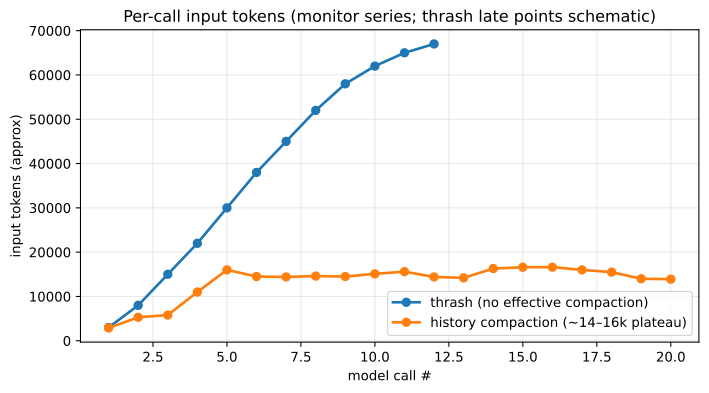
Figure: thrash late points are schematic midpoints from monitor notes (not a full exported series); compacted series follows the live plateau description. Use for shape, not millimetric accuracy.
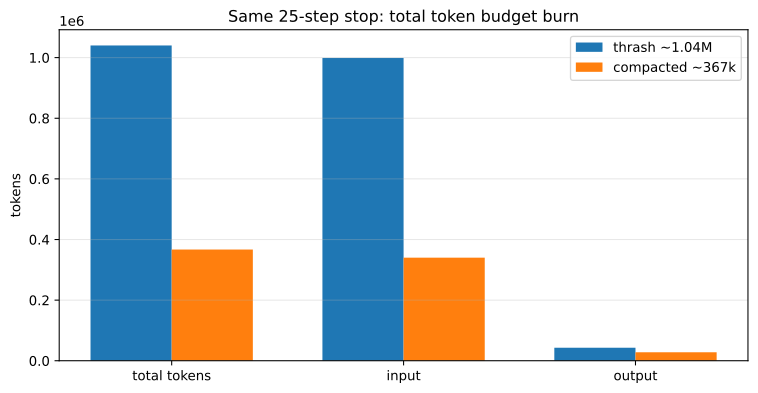
Figure: same stop condition (max_iterations / steps), very different bill — driven by input.
Core argument#
1. RLM efficiency is a policy surface#
A recursive loop gives you places to intervene:
| Knob (strategy YAML) | Role |
|---|---|
history_keep_recent_turns | Full fidelity window |
history_max_chars_per_old_message | Truncate older turns |
history_max_total_chars | Hard working-set ceiling |
history_protect_prefix_messages | Keep system/task head intact |
max_observation_chars | Bound what a single tool result injects |
These are implemented as history memory compaction applied before each model call (see history_memory.py, wired from rlm.py, defaults in rlm_config.yaml).
Inference: if you ship RLM with unbounded dialog concatenation, you have built a linear input escalator, not an efficient long-horizon agent.
2. Report input and output separately#
Session operators correctly pushed for in/out split. Totals hide the failure mode:
| View | What you miss |
|---|---|
| Total only | Whether cost is “thinking” or “re-reading” |
| Output only | Looks fine while input explodes |
| Input per call | Shows plateau vs climb — the health metric |
Scoreboards and live monitors should treat last-call input and hist_chars under budget as first-class series.
3. Token wins do not imply task wins#
The compacted run was ~2.8× cheaper and kept hybrid cell discipline healthy — yet stopped at 25/25 steps with no FINAL and files_changed: []. Monitor notes show the model stuck on write mechanics (triple-quoted report cells → parse errors; chunked open; bash heredoc) while input stayed flat.
So compaction fixed the wrong bottleneck relative to the operator’s hope for a finished review, but the right bottleneck relative to the token question. Both statements can be true.
Worked example (reading a live monitor)#
Hypothetical line from a healthy compacted turn:
turn 14 in≈16.3k out≈1.5k hist_chars≈51k/64k tools 36/1000 file? noInterpretation checklist:
- in flat → memory policy holding.
- out modest → not “novel-writing” the whole report into chat (or failing while trying).
- file? no after many “about to write” turns → success metric is still red; do not extend budget expecting tokens to be the issue.
Contrast thrash:
turn 14 in≈55k+ out≈2k hist growing tools climbing file? noHere extend-or-kill decisions should prioritize history policy and re-scan behavior, not only more steps.
Counterfactuals and alternatives#
-
If RLM were token-efficient by construction, per-call input would stay roughly constant as turns increase under a fixed task. The thrash series falsifies that for an uncompacted dialog loop.
-
Alternative to truncation: externalize state into the REPL workspace (files, variables) and keep dialog thin by design. Compaction is a harness-side mitigation when the model keeps stuffing observations into chat history instead of files.
-
Aggressive summarization counterfactual: replace old turns with LLM summaries. Might save more tokens but risk losing error strings needed to stop write thrash — a different tradeoff, not measured here.
-
What would reverse the ~2.8× win? Disable history caps with the same model and task length; expect input climb and totals back toward thrash order-of-magnitude. Provisional without a controlled re-disable A/B on identical seeds.
Limitations#
- Thrash late-call series in the figure is reconstructed from monitor narrative, not a full CSV export; magnitudes match session notes, exact per-turn list may differ.
- Both runs hit a step ceiling without deliverable; token comparison is for same stop, not same success.
- Compaction parameters (
keep_recent_turns, caps) were those of the exploratory/default strategy path in flight that day — not a full grid search. - Does not measure nested recursive depth costs separately from root dialog length.
- Write-path failure modes deserve their own note; they are only a boundary condition here.
Takeaways#
- Assume dialog RLM will grow input until you stop it. Ship history working-set knobs on day one.
- Dashboard in and out separately; watch per-call input plateau.
- Token health ≠ task health. Pair token series with artifact checks (
files_changed, review path exists). - Strategy binding should include history caps alongside cell/tool budgets — see strategies article.
- Next measurement: export full per-call in/out from
model_invocationsfor thrash vs compact runs into a checked-in CSV so figures need no schematic fill.
Regenerate figures#
cd $HOME/work/authoring
uv run --project publish/framework python \
  publish/framework/scripts/generate_rlm_article_figures.py