
Thesis. Making an agent emit smaller, fewer code cells per turn is often treated as an unalloyed good — tighter discipline, less thrash, easier observation. In a controlled GLM 5.2 A/B, that intuition held for cell shape and failed for task completion under a short root-step budget.
This is a research note from live recursive-RLM dogfooding (2026-07-17), not a claim about all models or all task lengths.
Context#
The harness drives agents through a recursive REPL loop: the model emits fenced Python “cells,” the harness executes them, returns observations, and continues until FINAL, budget exhaustion, or HITL pause. Models differ wildly in how many fences they emit per call.
- DeepSeek-style dogfood often converged with one-cell-ish turns.
- GLM 5.2 under default multi-block prompting often dumps many fences in a single response.
A natural operator reaction is: prompt the model to prefer smaller cells. We tested that with prompting only — no hard max_code_blocks_per_turn — on a short plan-mode Docker security probe (10 root steps, 50 tool calls).
Related pieces in this series:
- RLM token efficiency and history compaction — when the cost problem is input growth, not cell count.
- Strategies, not model
ifs — why cell policy should be a selectable strategy, not a global moral.
Experimental setup#
| Arm | Run ID | prompt_style | Extra |
|---|---|---|---|
| A baseline | run_20260717_051146_662977 | multi_block | none |
| B small-cell | run_20260717_051259_4183a5 | single_block | system addon: prefer ≤1 short cell/turn |
Same task fixture family, same model family (GLM 5.2), difference is prompting. Full baseline write-up: $SOURCE_REPO_ROOT/eval/baselines/glm-cells-prompt-ab-2026-07-17.md.
Operational footnote (provisional for interpretation): the first B attempt failed with a Docker daemon race while another run shared the host Docker; the reported B metrics are from a clean re-run.
Results#
| Metric | A baseline | B small-cell | Δ (B−A) |
|---|---|---|---|
| Outcome | completed / FINAL | blocked (hit 10 steps, no FINAL) | — |
| Iterations | 1 | 10 | +9 |
| Total cells | 5 | 15 | +10 |
| Cells/turn mean | 5.0 | 1.5 | −3.5 |
| Cells/turn max | 5 | 6 | +1 |
| Cells/turn series | [5] | [6,1,1,1,1,1,1,1,1,1] | — |
| Code chars mean | 299 | 92 | −207 |
| Code chars median | 318 | 64 | — |
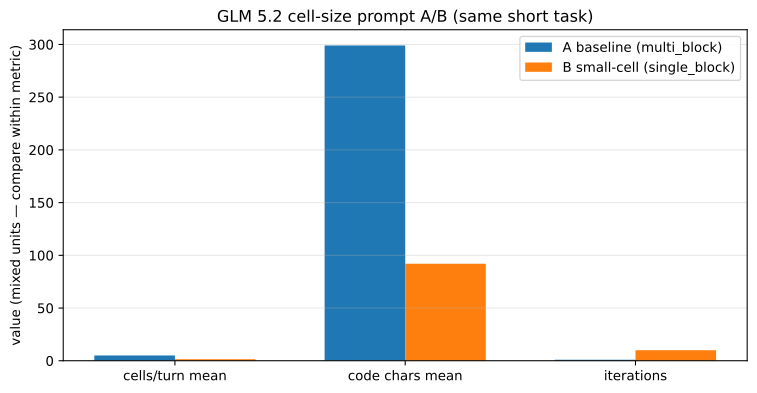
Figure: mixed-unit grouped bars — compare bars within each metric, not across metrics.
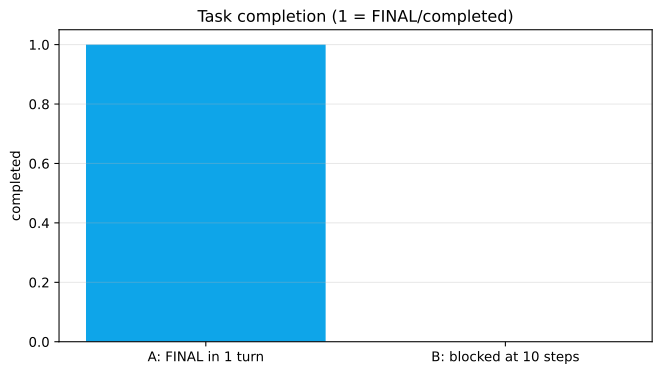
Figure: A reached FINAL; B did not under the same step ceiling.
What the cell series shows#
After turn 0, arm B stayed at one cell per turn for nine turns. Mean cell text was roughly 3× shorter. Prompting did change behavior.
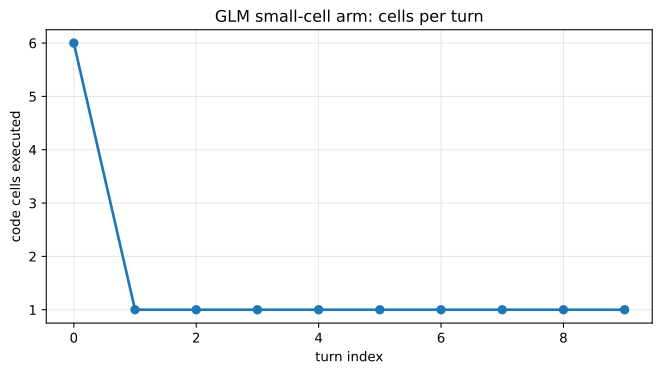
Figure: sticky multi-fence open (6), then disciplined single-cell turns — and still no FINAL by step 10.
Core argument#
1. Cell discipline is not the objective function#
Arm B optimized a proxy operators care about (cells/turn, code length). Arm A optimized what the eval actually scored: finish the short probe.
On a 10-step budget, a multi-block turn that does five related micro-reads/writes can be the efficient encoding of “one planning step.” Forcing one micro-step per model call multiplies model rounds, each with its own latency and fixed overhead, until the step ledger hits the wall.
2. The first turn is sticky#
Even with single_block + “prefer one short cell,” B still opened with six fences once. System-style guidance is not a hard guarantee on the opening multi-step plan dump. If your risk is “turn 0 burns the tool budget,” prompting alone is insufficient — you need engine caps or deferred-cell policies (see the strategies article).
3. When smaller cells are the right medicine#
The same session’s longer GLM security-review thrash suggested the opposite failure mode: many cells, re-scans, and tool-budget blowups without a deliverable. There, smaller cells (or hybrid late-phase caps) are aimed at reducing thrash over long horizons, not at winning a 10-step probe.
Inference (labeled): short probes reward batching; long exploratory reviews may reward turn discipline + write-early pressure. Collapsing both into “always small cells” is a design error.
Worked example (operator reading)#
Suppose you only look at dashboards:
| Dashboard signal | B looks… | Actual task outcome |
|---|---|---|
| Cells/turn | excellent | blocked |
| Code chars | excellent | blocked |
| Iterations used | “working hard” | exhausted |
| FINAL / artifact | — | missing |
Without an outcome column (FINAL, files_changed, verify score), B would win a beauty contest and lose the job.
Counterfactuals and alternatives#
-
If the claim “smaller cells always help” were true, B should match or beat A on completion under the same budgets. It did not on this short task. That falsifies the universal form of the claim for this setup.
-
Alternative explanation for B’s failure: not cell size, but slower exploration under a hard step cap. A soft time/token budget with more steps might let B finish — then small cells would look neutral or positive. That is a different experiment, not a rescue of the universal claim without new data.
-
Hard cap counterfactual: set
max_code_blocks_per_turn: 1in the engine (disciplined strategy) instead of prompting. Expect even less first-turn leakage; completion effect still depends on step budget. Not run in the published A/B (prompt-only by design). -
Long-horizon counterfactual: re-run A/B with 40+ steps and an artifact-based success metric (
reviews/*.mdexists). Prediction from session notes: B or hybrid may dominate A if A thrash-burns tools early. Provisional until re-run.
Limitations#
- n = 1 pair of successful comparable runs (plus one Docker-failed B attempt). Treat effect sizes as directional, not population estimates.
- Prompt-only intervention; engine cell caps and hybrid schedules are out of scope for this note’s numbers.
- Task is a short plan-mode probe, not a full security review deliverable.
- Model: GLM 5.2 via the harness profile path; do not export conclusions to “all multi-fence models” without replication.
- Metrics for thrash vs compaction live in the companion token article; do not mix those totals into this A/B.
Takeaways#
- Measure completion, not only cell aesthetics. Cells/turn is a diagnostic, not a success metric.
- Match cell policy to horizon. Short step budgets can make multi-block batching more efficient.
- Prompting moves means; it does not seal turn 0. For hard guarantees, use strategy knobs (
max_code_blocks_per_turn, hybrid late phase) described in the strategies article. - Next experiment worth running: same A/B with artifact success + longer step budget; report cells/turn and FINAL and tokens in/out.
Reproduce#
cd $SOURCE_REPO_ROOT
# Set RUNNER_CLI and POLICY_FILE to the local runner and policy file.
uv run "$RUNNER_CLI" run create eval/packs/fixtures/glm_cells_baseline.yaml --policy "$POLICY_FILE"
uv run "$RUNNER_CLI" run create eval/packs/fixtures/glm_cells_smallcell_prompt.yaml --policy "$POLICY_FILE"
# prepare + start each, then:
uv run python scripts/glm_cell_benchmark_report.py <baseline_rid> <smallcell_rid>Figures in this article:
cd $HOME/work/authoring
uv run --project publish/framework python \
  publish/framework/scripts/generate_rlm_article_figures.py